Short-Load Concrete: When a Trailer or a 3 1/2 Yard Truck Makes More Sense Than a Full Mixer
A walkway, a pad or a set of footings often needs one or two yards, and there are two ways to get that from us.
October 7, 2026 · 4 min read
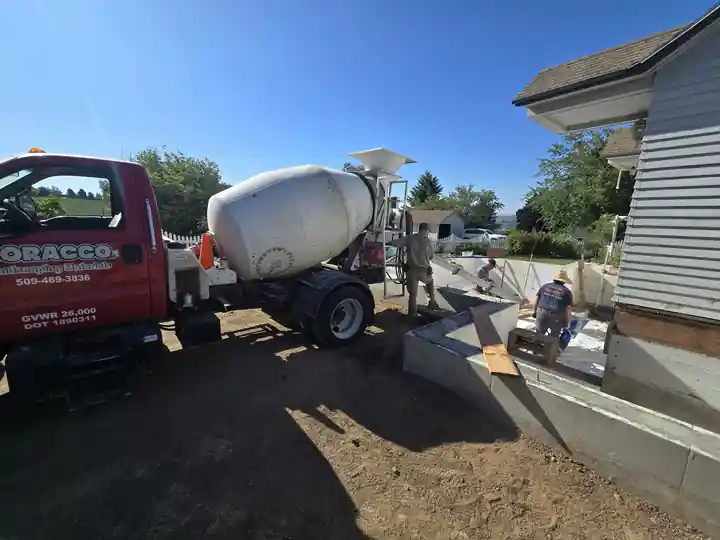
Ready-mix concrete is usually built around big loads. A full mixer truck often carries far more than a walkway, a shed pad or a set of fence footings needs, and a homeowner can end up paying for concrete that has nowhere to go. That's the gap short loads fill. We call ourselves the short-load specialists, and this is how we think about which of our two options fits your job.
Start with the yards
Concrete is measured in cubic yards, the same as gravel. Length x width x thickness in feet, divided by 27. A 10 foot by 10 foot pad at 4 inches thick is about 33 cubic feet, which is a little under 1 1/4 yards. A sidewalk 3 feet wide and 30 feet long at 4 inches thick comes to just over 1 yard. Four inches is a common thickness for walkways and patios, and driveways are often thicker, so check what your project calls for before you order.
Order a little over your number. Subgrades are never perfectly flat, forms can bow a bit, and running out halfway through a pour is the worst outcome you can have with concrete, because the first part keeps setting while you wait for more.
Option one: pick up one of our trailers
You can come pick up concrete in one of our trailers. The sizes and prices posted on our concrete page are:
- 1/4 yard: $120
- 1/2 yard: $140
- 3/4 yard: $182
- 1 yard: $218
- 1 1/4 yards: $272
- 1 1/2 yards: $327
- 1 3/4 yards: $381
Prices can change, so call to confirm before you plan around them. Concrete weighs roughly 4,000 pounds per yard, which is why the tow vehicle matters. Here is what we need from you:
- A valid driver's license and current proof of insurance.
- A properly sized tow vehicle: a 1/2 ton for the 1 yard trailer and a 3/4 ton for the 1 3/4 yard trailer.
- A 2 inch ball and a 4 prong flat plug. No bumper pull.
- A trailer deposit of $150.
- Two hours of rental time are included. After that it's $25 an hour.
Two hours is shorter than it sounds if you're not ready. Before you leave the yard, have the forms set, the base compacted and dampened, a helper or two lined up and your tools at the site. Concrete doesn't wait while you look for the float.
Option two: we deliver in our 3 1/2 yard truck
If you don't own the tow vehicle, or you'd rather not haul 4,000 pounds a yard through town, we can deliver in our 3 1/2 yard truck. A smaller truck has real advantages on a house lot. We can access areas that larger trucks cannot. It's a lighter truck, so there's less chance of damaging property such as driveways and lawns. Scheduling is more flexible, and we operate on Saturdays, which helps when the weekend is your only window for form work and finishing.
Delivery details depend on the job, so call with your yardage and your address and we'll go over them with you.
Color, stamps and finishing
We provide color, stamps, tools, forms, sealers and the knowledge to make your project a success. If you want color, we can add it to your concrete during the batching process. Our color chart is there to show the range available, and it isn't a reliable way to pick a color from a computer screen, so look at samples in person. If stamped concrete is the plan, you can do it yourself, or we can connect you with one of our professionals to complete the project for you.
Hot summers, hard freezes and the mix
Central Washington swings from hot, dry summers to winters that freeze, and concrete reacts to both. Admixtures are how a batch gets adjusted to the day. Here is how we describe four of them on our concrete page:
- Hot weather delay admixtures slow the set of freshly placed concrete. They offset the speed-up from high temperatures and give you more time to place it.
- Cold weather accelerating admixtures help offset low temperatures by increasing the rate of cement hydration, which aids setting time and early strength. Dose rates vary with the temperature at the job site.
- Air entrainment increases the durability of hardened concrete, especially in climates with freeze-thaw cycles, and it also improves workability. It's used for exterior applications.
- Water reducers let a mix stay workable with less water. Less water can mean stronger concrete, by up to 25 percent according to our page.
In practice, a slab poured in July and one poured in December need different handling. Tell us the date, the forecast and what the concrete will be doing, such as a driveway that sees hard use or a patio that stays dry, and we'll talk through what suits it. Beyond the mix, good habits are typically the same all year. Keep fresh concrete from drying out too fast in heat, protect it from freezing during the first days, and don't add extra water at the site to make it easier to push around.
Call the yard at (509) 469-3836 with your yardage and your address, or come by 31 W Washington Ave in Yakima. From November through mid-March the yard runs on appointments, and hours depend a lot on the weather, so if it's questionable, call before you drive out.
Soracco Landscaping Materials, (509) 469-3836
Call (509) 469-3836More articles
How Many Yards of Gravel Do I Need?
Length times width times depth, divided by 27, plus a little extra: the whole job takes about two minutes and a tape measure.
Choosing Decorative Rock for a Yakima Yard: Montana Rainbow, China White, Champagne, Red Lava and Yellow Pathway
Five decorative rocks from our bins, how they differ and how to lay any of them so the bed still looks good in five years.