Building a World Block Retaining Wall: Setback, Curves and What a Skid Steer Can Lift
These blocks are large enough for demanding jobs and small enough for light equipment, which is why planning matters as much as stacking.
October 7, 2026 · 4 min read
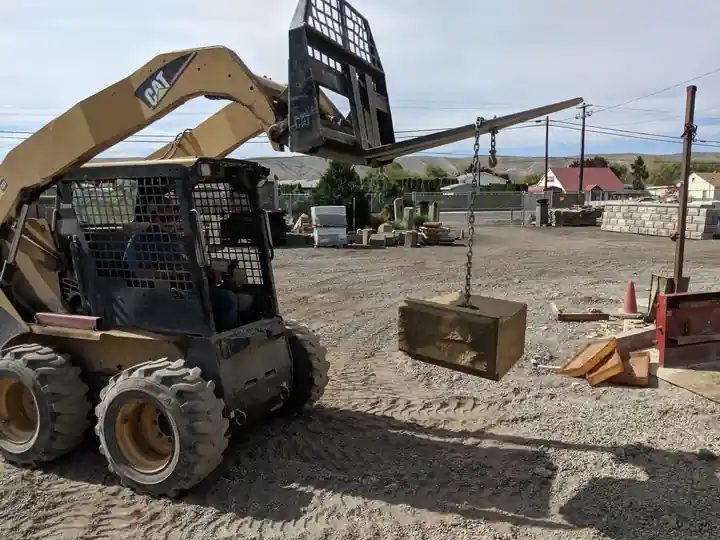
World Blocks are the precast retaining wall system we stock. Here is how our page puts it: "If you're looking for a landscape block large enough for demanding jobs, yet small enough to be handled with light-duty equipment, World Blocks are the perfect solution." They're a project you plan, though, and this post covers the parts worth thinking through before you order.
What the blocks are
- Singles: 2 feet long, 2 feet deep, 1 foot high, about 560 pounds.
- Triple blocks, listed as 3 across: 6 feet long, 2 feet deep, 1 foot high, about 1,600 pounds.
- We also stock corners, half blocks and caps.
For a rough count, divide your wall length by 6 to get triples per course. A 30 foot wall takes five triples in each course. Each course is 1 foot high, so a wall 4 feet tall above grade is about four courses, plus whatever you bury below grade and whatever the cap adds. Give us your wall length and height and we'll go through the count with you.
The one inch setback
Our page says it plainly: "World Blocks are designed with a one-inch setback on every course, allowing the wall to naturally lean back into the earth it is retaining for added strength and stability." You don't have to build the lean in. It comes with the block.
The math is simple. Each course steps back an inch, so a wall five courses high leans back 5 inches from bottom to top. That means the top of the wall sits 5 inches closer to the slope than the bottom does. If the wall runs near a fence or a property line, measure from the top edge as well as the bottom when you lay it out.
Curves
Our page also says: "The blocks also feature tapered sides, allowing you to create curved walls with a radius as tight as 6 feet (measured to the back of the block)." A curve is where a block wall starts to look designed instead of just built.
Two things help. Mark the curve on the ground with a hose or paint before you dig, and look at it from the house and from the street. And remember that with a setback on every course, a curve's radius may change as the wall climbs, depending on which way it bends. Test a few blocks dry on the base before you commit to the layout.
What a skid steer can lift
Our page says each block is light enough to be handled with a skid steer, and we lift them that way ourselves, by chain, in the yard. Light enough doesn't mean any skid steer will do. A 1,600 pound triple is a real load, and the number that counts is your machine's rated operating capacity, which you'll find on its data plate. A block hanging on a chain out in front of a machine behaves like a heavier load than it looks, so leave yourself a margin, keep the block low and don't work on a slope you wouldn't park on. Keep hands and feet clear of anywhere a swinging block could pin them. If your machine's rating is close, setting singles is a safer plan than forcing triples.
We supply the blocks, and we'd rather you line up the machine and the operator before the blocks are on order than after. Ask us how your blocks would get to your site when you call.
Base, drainage and the rules
A block wall is only as good as what's under and behind it. Typically that means a level, compacted base, a first course set carefully because every course after it follows, and a column of clean drainage rock behind the wall so water has somewhere to go instead of pushing on the blocks. We sell 1 1/2 drain rock and 3/4 clean chips, so ask which suits your wall. A 20 foot wall 4 feet high with a foot of drainage rock behind it works out to 80 cubic feet, about 3 yards. In the yard's online store in October 2026, drain rock is listed at $56.00 per yard, and that may change.
Then the part nobody wants to hear. Taller walls, walls that hold up a driveway or a building, walls close to a property line and walls on steep or wet slopes may need an engineer's design, a permit or both. The height where that starts depends on where you live and what the wall is holding. We don't set those rules, and we can't tell you which ones apply to your lot. Call your city or county building department before you order and ask what they require for your wall.
Come see the blocks at 31 W Washington Ave in Yakima, or call (509) 469-3836 to talk through your wall. We can help you work out block counts and drain rock quantities. From November through mid-March the yard runs on appointments, so call ahead.
Soracco Landscaping Materials, (509) 469-3836
Call (509) 469-3836More articles
How Many Yards of Gravel Do I Need?
Length times width times depth, divided by 27, plus a little extra: the whole job takes about two minutes and a tape measure.
Short-Load Concrete: When a Trailer or a 3 1/2 Yard Truck Makes More Sense Than a Full Mixer
A walkway, a pad or a set of footings often needs one or two yards, and there are two ways to get that from us.